The knife is one of the earliest tools developed by humans. It has served humanity for thousands of years and continues to be an essential tool today. Whether made from stone, bone, or metal, knives have been used for a wide variety of tasks, including skinning animals, preparing food, making other tools, and self-defense. Throughout history, knives have been carried by farmers, soldiers, and ordinary people, and they remain widely used today.
Over time, the simple knives made from stone or bone evolved into more sophisticated designs. As technology and metallurgy advanced, knives became stronger, sharper, and more efficient. Handles were introduced and improved to provide a more ergonomic and comfortable grip. In addition to fixed-blade knives, folding knives were developed, offering a more compact and convenient way to carry a blade.
Fixed-Blade Knives
A fixed-blade knife is a knife with a blade that does not fold or move. It generally has a simpler construction than a folding knife, with no moving parts in the blade mechanism. The blade and tang are typically made from a continuous piece of steel, although some designs use different construction methods.
The tang is the portion of the blade that extends into the handle. There are several types of tang construction, with full tang and rat-tail tang being two examples. A full-tang knife has a tang that extends along most or all of the handle’s length and usually follows its general shape. This construction is valued for its strength and durability. A rat-tail tang, on the other hand, has a narrower extension that runs into the handle. Its strength depends on the design, materials, and overall construction of the knife.
Folding Knives
There are many different types of folding knives, distinguished in part by their opening and locking mechanisms. Common designs include slip-joint, lock-back, and friction folders. Other models use mechanisms such as liner locks, frame locks, or safety rings to help secure the blade in the open position.
Folding knives are popular because they are compact, convenient, and generally easy to carry. When closed, the blade is protected within the handle, making the knife suitable for everyday tasks. Some folding knives feature a single blade, while others have multiple blades designed for different purposes.
Advantages and Disadvantages of Fixed-Blade Knives
Fixed-blade knives offer several advantages over folding knives. Their straightforward construction can make them strong, robust, and suitable for demanding tasks. Because they do not rely on a folding mechanism, they have fewer moving parts that can wear out or become obstructed by dirt.
Fixed-blade knives are available in a wide range of sizes, from small models for light tasks to medium and large knives designed for more demanding applications. This variety allows users to select a knife that suits their intended needs.
However, fixed-blade knives also have some disadvantages. They are often heavier and bulkier than folding knives of comparable blade size, and they usually require a sheath for safe carrying. Depending on the materials, manufacturing process, and design, some models can also be more expensive. My personal favorite small fixed blade knife is the LTWK Patriot,and you can see my review at https://www.scrambleroutdoors.com/ltwk-patriot-the-best-compact-everyday-carry-blade/
Common carrying methods include a belt sheath, pocket carry where appropriate, and neck carry using a suitable sheath. The best method depends on the knife’s size, weight, design, and intended use, as well as applicable laws.
Advantages and Disadvantages of Folding Knives
Folding knives are generally lighter and more compact than fixed-blade knives, making them convenient for everyday carry. Their folding design allows the blade to be stored inside the handle when not in use, reducing the space required for carrying.
Some folding knives feature multiple blades, while others include additional tools for different tasks. Many models are equipped with a pocket clip, allowing them to be attached to a pocket or similar location for convenient access.
Folding knives are available in various sizes, weights, and blade profiles. Some feature thick, robust blades, while others have slimmer, more traditional designs intended for lighter tasks. The overall weight depends on factors such as blade thickness, handle materials, locking mechanisms, and the number of additional tools.
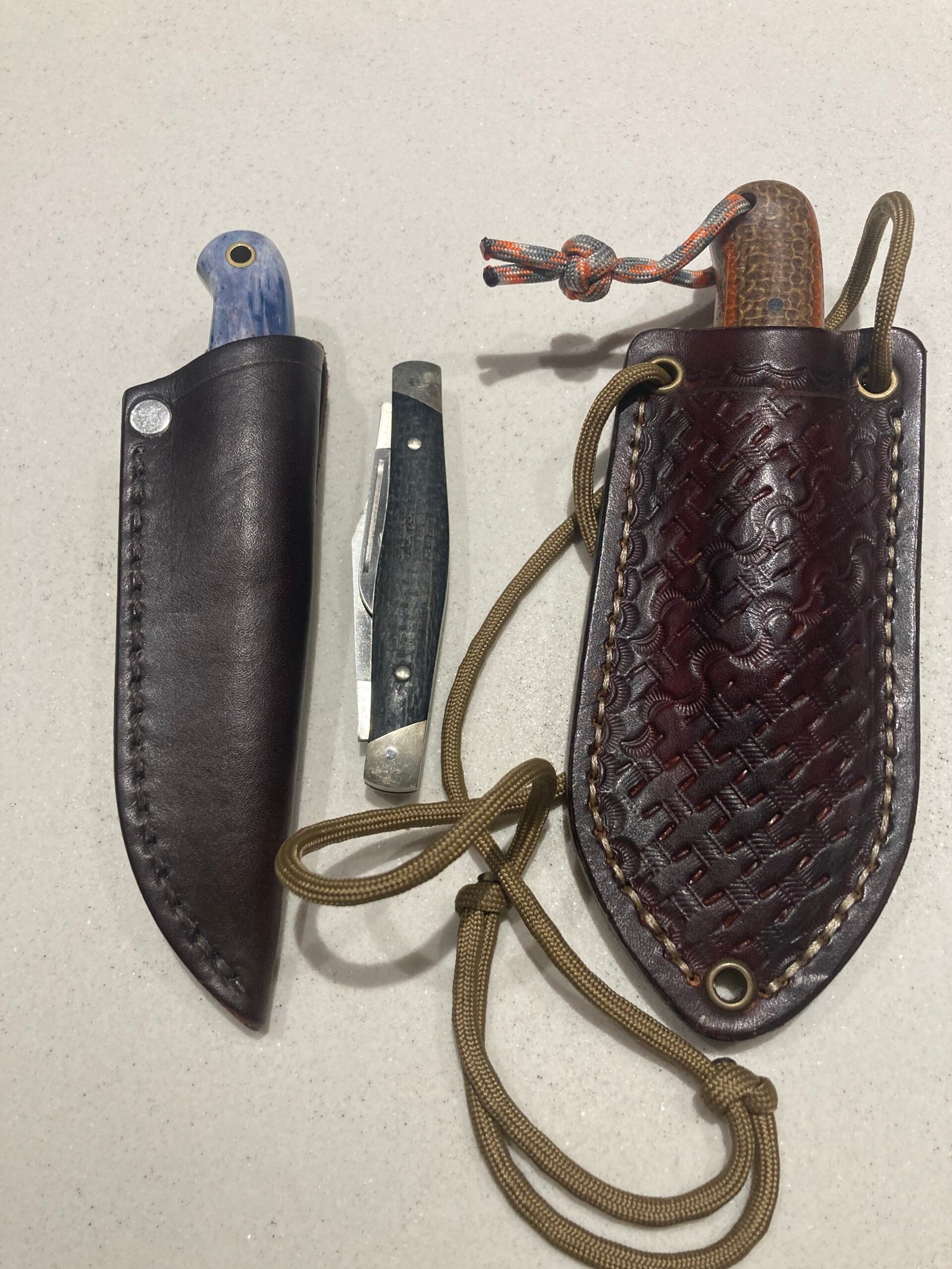
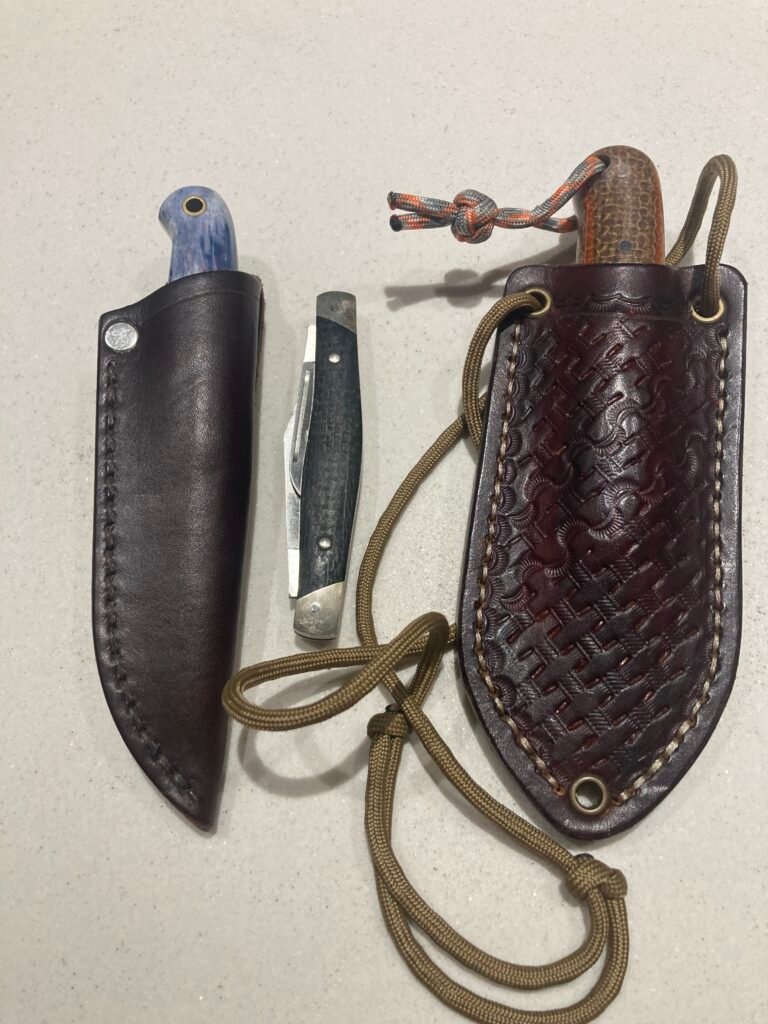
Traditional folding-knife designs often have a slim profile, making them relatively discreet and easy to carry. Some larger folding knives come with a sheath for belt carry, providing an alternative to carrying them in a pocket. Prices vary considerably depending on the materials, manufacturing quality, design, and brand. I am a big fan of traditional pattern folding knives. I always have in my pocket either the special edition Buck you are seeing in photo, or a Case Muskrat.
Although folding knives are convenient and versatile, their mechanisms introduce additional moving parts. These components may require maintenance and can be more vulnerable to dirt or wear than the simpler construction of a fixed-blade knife.
Knife-Carrying Laws and Responsibilities
Before carrying a knife, it is essential to understand the laws and regulations that apply in your location. Restrictions vary between countries and may also differ by region or municipality. Some jurisdictions restrict the carrying of fixed-blade knives, while others impose limits on folding knives, blade lengths, locking mechanisms, or the circumstances in which a knife may be carried.
In some places, carrying a knife in public may be restricted even when owning it is legal. Certain locations, such as schools, government buildings, and public events, may have additional rules.
Responsible knife ownership involves more than choosing the right tool. It also means understanding the applicable legislation, carrying a knife only when legally permitted, storing it safely, and using it appropriately.
Ultimately, both fixed-blade and folding knives have their own advantages and limitations. The most suitable choice depends on the intended task, personal requirements, portability, maintenance, and local legislation.
Buy LTWK Patriot at: https://mdggifts.com/LTWK-Patriot-A2-Flat-Green-Micarta_p_6752.html
Buck Knives site: https://www.buckknives.com/?srsltid=AYCX9vIR0pcr_kVQqfLeqnJhvVSHARCjJumO78sC054laLKI6Eusz2AK
Case Knives site: https://caseknives.com/?srsltid=AYCX9vJWFLDiMmPfjbp9w3DIcYvzc9KziU43Jb9ZAVoYZrklMW0TGKk7